

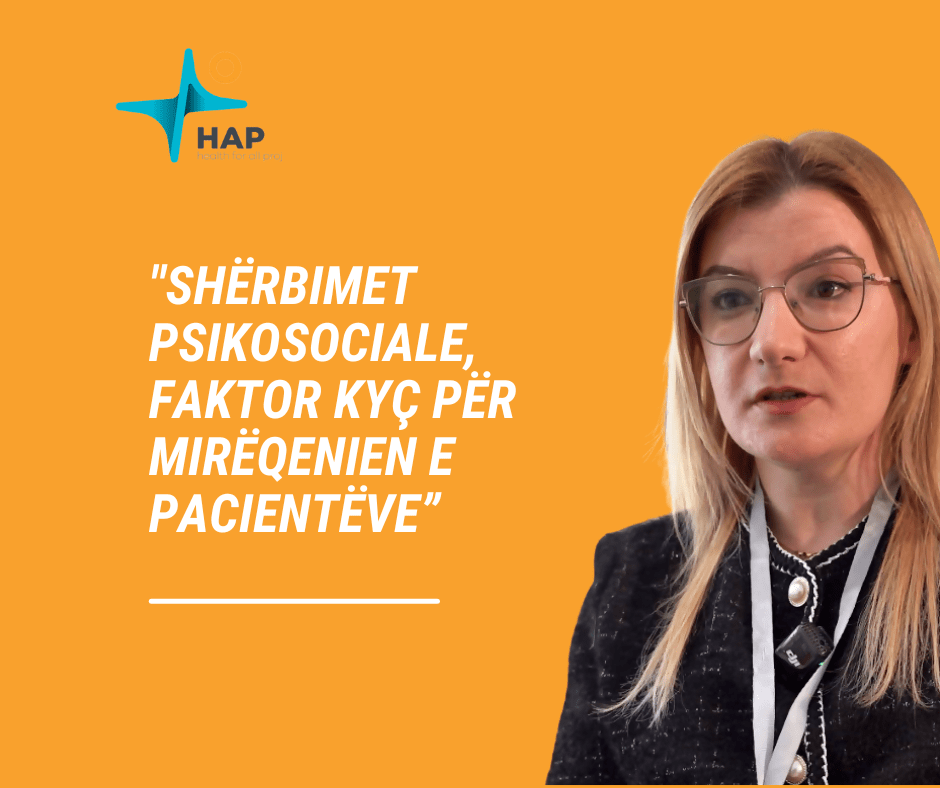
Lulzime Gjyriqi is a licensed social worker with approximately 12 years of professional experience in areas including combating human trafficking, domestic violence, community empowerment, work with migrants, and the education system. For the past three years, she has worked as a social worker at Socio-Health Centre No. 7 in Tirana. She has also been an external lecturer at the Faculty of Social Sciences for the past five years, teaching courses focused on social casework, counselling, and social policy. Throughout her career, she has contributed as an expert to various national and international projects. Since 2023, Ms Gjyriqi has served as the Regional Coordinator for Kukës within the Order of Social Workers in Albania and is also a licensed supervisor.
What are the social problems that most frequently affect patients’ health but cannot be addressed by the doctor or nurse alone?
Without question, the most common issues are financial hardship, unemployment and low wages, all of which ultimately affect people’s quality of life, health and ability to purchase medicines that are not covered by the state reimbursement scheme.
Family problems, interpersonal relationships and lifestyle-related issues are also closely intertwined with health. However, these cannot be adequately addressed by healthcare professionals alone without the involvement of a psychosocial services professional.
Could you provide a practical example of:
- How the social worker has been integrated into the multidisciplinary team at the socio-health centre?
- How you collaborate in practice with the family doctor and family nurse?
- How decisive the social worker’s intervention has been for the patient’s well-being?
Most of my referrals come from family doctors and family nurses. Once they identify something in a patient that appears to require psychosocial assessment, they refer the patient to me.
For example, I have received referrals for what initially appeared to be behavioural problems or emotional fluctuations. However, during the assessment process, it became evident that the underlying issues were much more complex. Through the referral system, we were then able to ensure that the patient accessed the appropriate services and received care in a dignified manner.
In practice, I maintain communication with the family doctor regarding every case, either through direct discussions or written feedback and recommendations. I specify the interventions that have been carried out and provide recommendations for further management.
The social worker’s intervention has been decisive in many cases that genuinely required ongoing follow-up. I consider it essential that every patient I work with is given, at the very least, the opportunity to feel heard and accepted.
How would you assess the support provided by the health management structures (Local Units of Healthcare, the Health Care Operator, and the Ministry of Health and Social Welfare) for this relatively new profession?
I believe that considerably more could—and should—have been done than simply creating vacant positions within socio-health centres.
In my view, integrating a new profession into an institution requires a comprehensive approach across all components of the system. This includes clearly defining the professional’s position within the institution through a job description, developing protocols and working tools, providing appropriate dedicated workspace that meets professional standards, ensuring social workers are treated with dignity according to their professional category within the health system, and providing fair remuneration.
What changes for patients when they receive social support alongside healthcare? How does this approach contribute to earlier identification of vulnerable cases?
One sentence we hear repeatedly from patients when they come to our service is:
“Oh, that’s wonderful—I didn’t know this service was available here as well.”
From that moment, we immediately realise how valuable this service truly is for patients and how important it is for them simply to have someone who listens to them.
We have successfully managed cases involving both social issues and mental health concerns, including stress management, anxiety and lifestyle changes. These cases were resolved without the need to refer patients to a psychiatrist.
This integrated approach brings patients closer to the service and naturally facilitates the earlier identification of vulnerable individuals.
You were part of the working group that developed the Manual for Social Workers in Primary Health Care. What gap does it fill in the day-to-day practice of social workers?
The Manual is the only guidance document specifically designed to direct the work of social workers in primary healthcare. It serves as a practical reference that supports our daily practice while clearly defining the boundaries of our role and responsibilities.
Thanks to the Manual, we have a much clearer understanding of the scope of our interventions and what falls within our professional responsibilities.
How practical do you find the Manual’s guidance and tools? What would be needed to implement them more effectively?
In my opinion, successful implementation of the Manual—and, more broadly, the integration of psychosocial services into primary healthcare—depends on recognising social workers as integral members of primary healthcare teams.
This includes:
- providing training for social workers working in socio-health centres on the practical application of the Manual;
- granting access to the electronic platform of the Compulsory Health Care Insurance Fund for reporting activities and facilitating communication in the patient’s best interests;
- documenting the services we provide in the patient’s medical record;
- establishing clear criteria and indications for direct referrals initiated by social workers to services outside the socio-health centre; and
- monitoring our work using indicators and performance measures that reflect the specific nature of the services we provide.
- HAP has supported the integration of psychosocial services into primary healthcare for several years. In your opinion, what have been its most important contributions, and how do you assess the project’s support?
For me, HAP’s support has been the most significant contribution because, as I mentioned earlier, creating positions and recruiting psychosocial professionals into socio-health centres alone is not enough.
HAP has helped place psychosocial services within primary healthcare on a much more concrete footing. It developed dedicated practice manuals for both social workers and psychologists working in primary healthcare. It also provided training for these professionals alongside family doctors and family nurses on the management of mental health disorders.
In addition, HAP supported the development of these newly integrated professionals by establishing and strengthening Peer Groups, enabling the wider healthcare team to better understand their role and promoting closer multidisciplinary collaboration.
In your opinion, what remain the main challenges to fully integrating these services into primary health care throughout Albania?
For psychosocial services to become fully integrated into primary healthcare, it is first and foremost essential that the value of these services is recognised and that these professionals are treated with the same dignity and respect as every other healthcare professional.
In this regard, I believe regular multidisciplinary meetings involving family doctors, family nurses, social workers and psychologists would be extremely valuable. Such meetings would allow us to better understand each other’s day-to-day practice, clarify our respective roles and responsibilities, and ultimately improve the management of patients and their complex needs.
From the perspective of service accessibility, however, significant challenges remain. These largely stem from the stigma surrounding mental health problems, as well as cultural attitudes and community perceptions that continue to discourage people from making use of psychosocial services.