

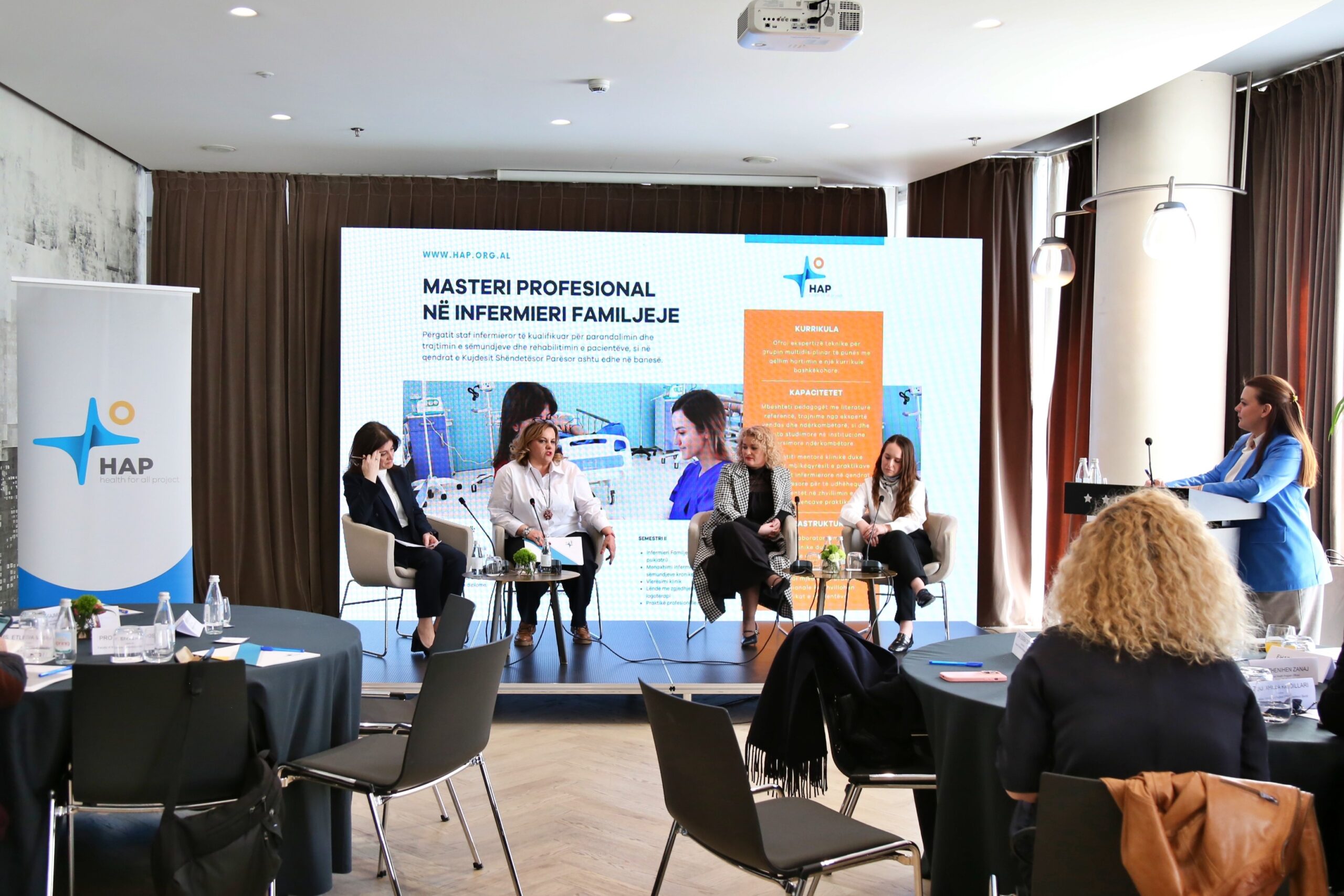
On 25 March 2026, the Health for All Project (HAP) held its first activity of the capitalisation stage, focusing on:
“Collaboration with universities for human resources development in primary health care.”
The roundtable discussion took place at Hotel Plaza in Tirana and brought together a broad range of stakeholders from the health and academic sectors, including representatives from the Faculty of Medicine, the Faculty of Economics, and the Faculty of Technical Medical Sciences, as well as key institutions such as the Ministry of Health and Social Welfare, the Health Care Services Operator, and development partners.
The discussion centred on three main components supported by HAP:
- the Master’s programme in Health Management, aimed at strengthening managerial capacities;
- the Master’s programme in Family Nursing, closely linked to the development of community care and home-based services;
- and operational research, as a tool to support evidence-based decision-making.
Discussions were guided by key questions relevant to the capitalisation phase:
- what has worked in practice and why;
- where the gaps and challenges lie;
- and how the quality, accessibility, and sustainability of these interventions can be improved.
One of the main messages emerging from the roundtable was that HAP-supported interventions have already established a solid foundation. However, the key challenge remains their fuller integration into the system, particularly in terms of employment, career development, and service organisation.
The activity also highlighted the importance of:
- strengthening the link between academic qualifications and system incentives;
- increasing flexibility within study programmes;
- more clearly defining professional roles, particularly in nursing;
- and promoting the more systematic use of research in decision-making.
This roundtable marks the beginning of a series of thematic discussions that HAP will organise in the coming months, with the aim of consolidating accumulated knowledge and supporting the continuity of interventions at both policy and institutional levels